Thursday, 4 April 2013

The History of Punk Zines

One of the first ever punk zines created in the UK, was Sniffin' Glue. Brainchild of Mark Perry, Sniffin Glue paved the way for many other punks to enter the world of self publishing. With commentary on the local scene of Deptford, in South London, England, it featured much of the early punk music world with inspiration from the likes of the Ramones, and Blue Oyster Cult.

As you can see here from the cover of the first issue, released in 1976, Sniffin' Glue paved the way for early DIY and punk aesthetic in zine culture. With hand written text and low quality images, Mark Perry has been noted as the forefather of zine culture in the UK. (Chick, 2011) Sniffin' Glue is a great example of an original punk zine for many different reasons, including it's understanding and establishment of the DIY aesthetic, the criticism of bands signing up to major labels and an insight into the UK punk scene as a whole with interviews, reviews and memoirs. The zine only ran for 12 issues after leaving to concentrate on his punk music project, Alternative TV. (Chick, 2011)

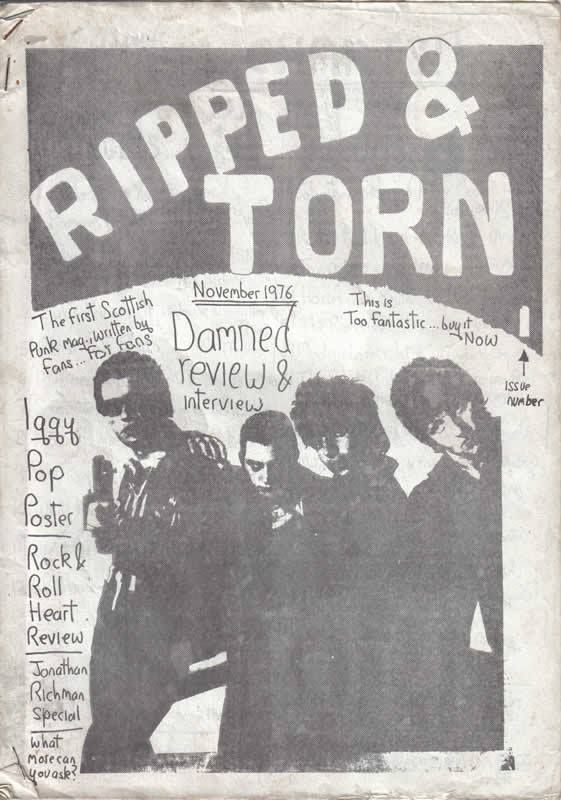
Entering the punk self publishing phenomenon in the same year was the Glaswegian fanzine, Ripped and Torn. Created by Tony D, Skid DeSade and Grant McNally, it featured many bands from the primal punk era of the 1970's such as The Damned, Sex Pistols and Iggy Pop. (Zine Wiki, 2010) Inspired by Mark Perry's Sniffin' Glue, it featured many of the same aesthetic, relying on photocopiers to create numerous copies of the zine for distribution. Connecting with local record stores, music papers, book shops and even Mark Perry himself, hundreds of copies were requested and sold in a matter of weeks, followed quickly by local press wanted to document this young punk's triumphs. Ripped and Torn also had a fairly short shelf life, with Tony D revoking all involvement in 1979. (Tony D, 2012)


The last punk zine I wish to document is the brain child of Aaron Elliot, better known as Aaron Cometbus, of which his most famous zine bears the same name. Cometbus started in the early 80's and submerged itself into the punk zine culture, although also featured many short stories, on a variety of different subjects. (Zine_Fiend, 2011) This aspect of Cometbus does establish itself as a per-zine, with influence from the subculture of punk. Cometbus followed the DIY and punk aesthetic of many zines of the time, however unique to the culture with the whole catalog of zines handwritten in their entirety. 


As you can see with the above image, low quality images, photocopied layouts and handwritten text were all part of the creative familiarity that was established within the punk zine culture of the time and still remains today. 

These three zines are directly influential to many punk zines of today and established a strong aesthetic within the DIY culture and community. The use of photocopiers, scissors and glue lead the way for a strong and healthy zine community, creating a flourishing do it yourself ethos to a generation of punks with voices to be heard. The timing of this self-publishing revolution was born within the technological race in the publishing industry, including the birth of the Xerox machine and commercially available printing methods. 


Mark Perry, (1976), Sniffin Glue Cover (ONLINE). Available at: https://blogger.googleusercontent.com/img/b/R29vZ2xl/AVvXsEhzi5RlH1_KdrCpQD7pCXpvqTr7NzUudK0tXRBHp60PJdZXfl0GfgxFrBTMsQYANgfJ8H7MO9cj0bFHW67sOaqbeOQ6EIP-KNCCFP9cYI2TopDsIHBmmjrcHOyk6-Jnkt8J5YeFRh-pku4/s1600/sniff+1.jpg Accessed 04 April 13.

Stevie Chick. (2011). Mark Perry gives birth to fanzine culture. Available: http://www.guardian.co.uk/music/2011/jun/14/mark-perry-fanzine-culture. Last accessed 4th April 2013.

Zine Wiki. (2010). Ripped and Torn. Available: http://zinewiki.com/Ripped_%26_Torn. Last accessed 4th April 2013.

Tony D. (2012). Ripped and Torn. Available: http://killyourpetpuppy.co.uk/news/the-modern-lovers-home-of-the-hits-records-1976/. Last accessed 4th April 2013.

Tony D. (1976), Ripped and Torn Cover (ONLINE) Available at: http://i192.photobucket.com/albums/z149/pengy1966/KYPPRT1.jpg Accessed 4th April 2013.

Zine_Fiend. (2011). Cometbus (Punk Zines, Vol. 1). Available: http://zines.wonderhowto.com/inspiration/cometbus-punk-zines-vol-1-0115169/. Last accessed 4th April 2013.

Aaron Cometbus, (1983), Cometbus #11. Available at: https://fbcdn-sphotos-h-a.akamaihd.net/hphotos-ak-snc7/418181_386050461413059_711753525_n.jpg Accessed 4th April 2013.

Sunday, 31 March 2013

Punk Sell Out

The idea of "selling out" when used in the punk rock world is something heavily frowned upon. What I plan to find out through this section is to understand and explore the definition and connotations that selling out entails. Understanding the DIY ethic allows an insight into the term of selling out, with it's adversity towards capitalism and corporations, it encourages, in the literal sense, a do it yourself attitude. This can be applied in many different areas in the punk rock scene, as well as within zine culture. In regards to punk, it encourages people to record their own records, make their own clothes and put on their own shows. In regards to zine culture, it encourages self-publishing, using commercially available printing equipment and techniques and hand to hand distribution. By recognising the ideals of the DIY ethic and what that entails, a betrayal of values can be interpreted through 'selling out' and it's understandable that to exchange your morals, principles and ethics for money, success and fame is something of a contradictory nature to the DIY scene as a whole.

To help better comprehend the idea of DIY and it's opposing concept of selling out, I've used Alistair Gordon's thesis, The Authentic Punk: An Ethnography of DiY Music Ethics (2005) as a key text in understanding the history and dilemmas within the DIY attitude and community. His exploration of the ethos was undertaken throughout the Leeds and Bradford hardcore punk scene and how the principles of the DIY ethos is relevant and applicable throughout many different aspects of punk rock, from venues to record stores to recording studios and the effect that has on the rest of the community. As Alastair Gordon explores the local scene in his area, he interviews a number of members from the 'scene', allowing him to delve deeper into the reasons behind the adoption of the DIY ethic into their lives.

Authenticity is a vitally important aspect of punk and DIY culture, Gordon finds out, due to the fact of many members' history before their involvement in the subculture. "Entering punk subcultural groupings rests on a fulcrum of disenchantment with the established world: a feeling of being at odds with one's peers, wishing 'cool' distance from them, or with society in general: in short a sense of difference. Where loneliness is produced by such feelings (conflict with parents, teachers, authority figures etc. ) it has the immanent potential to propel the individual to seek out and identify other peers who share the subcultural norms and values. But the opposite of loneliness, peer celebration, may prove the conditioning ground for punk." (Gordon, 2005) This statement explains that through a lack of connection with society, a sense of unbelonging and the desire to communicate with others sharing similar experiences led many of the interviewees into the world of punk rock and the DIY ideal surrounding hardcore punk in Leeds and Bradford. However, these case studies share a common knowledge and experience that is applicable on a much wider scale. There are many different reasons why people get involved with individual punk subcultures, but a deep misunderstanding of the world and the inability to fit into the 'norm' has led people to a way of life that through this deep connection has spurred an obsession to keep the ideals of the ethic pure and uncompromised.

However, there is a positive side to the argument of entering the industry culture. "Claiming that DiY cultural production is the only authentic form of culture, means that exclusivity is just around the corner: 'only' quickly becomes translated into 'elite'." By the 'elite' defining rules about what and what is not punk can be antagonistic towards the original intentions of the punk rock scene, to break rules and challenge boundaries. (Gordon, 2005) By denying association within the punk scene from fellow misfits, dictated by the 'elite', it can create an antithesis of the intentions of DIY. Using the involvement of the internet as an example, it's argued that this can disassociate many people from the original aims of punk and DIY, meaning that the music and the imagery can be interpreted without understanding the underlying ethics. (Hamlyn, 2013) However, by allowing this elitist attitude to dictate the nature of DIY and punk, on local, national and international scale, it can end with no participation in respects to music, zines, shows and a whole list of other DIY inspired projects. When involving something like the internet into a community based on pure ideals of do it yourself and the embrace of hand made culture, it can allow for better communication around the world, a huge source of inspiration and a whole community in itself passionate and focused in their ideals. This inevitable application of the internet and the opportunities it presents has meant many DIY enthusiasts are turning to the world wide web for inspiration, instruction and the potential of collaboration.


Alastair Robert Gordon (2005). The Authentic Punk: An Ethnography of DiY Music Ethics. PhD thesis, Loughborough University. p72.

Alastair Robert Gordon (2005). The Authentic Punk: An Ethnography of DiY Music Ethics. PhD thesis, Loughborough University. p10.

Alastair Robert Gordon (2005). The Authentic Punk: An Ethnography of DiY Music Ethics. PhD thesis, Loughborough University. p268.

Hamlyn, Daniel (2013). Interview with Naomi Girdler. 13th March 2013. Online.

Saturday, 30 March 2013

Punkademics, edited by Zack Furness


Zack Furness (ed). (2012). Punkademics. Brooklyn, NY: Minor Compositions.

p7. " And despite my initial anxieties over the prospects of compromising my then-entrenched punk ethics by turning into a stuffy academic, I actually ended up spending more time playing in bands and participating in various aspects of DIY punk culture as a graduate student and eventual professor than I did when I was younger."

p10. "At their best, the combinations of people, places, cultural practices, social relationships, art and ideas that co-constitute punk are rife with possibilities: creating new kinds of music or revelling in the ecstatic moments at the best shows; forging bonds of group solidarity and personal identity; carving out non-commercial spaces for free expression and the staking out of positions; and pushing people toward a participatory, ‘bottom up’ view of culture. Through the often conflicting accounts and histories of punk, one can identify the ebb and flow of countless scenes, interwoven subcultures, and a broader ‘Do it Yourself ’ (DIY) counterculture in which people put ethical and political ideas into practice by using music and other modes of cultural production/expression to highlight both the frustrations and banalities of everyday life, as well as the ideas and institutions that need to be battled if there is any hope of living in a less oppressive world. And crucially, people have a lot of fun doing it."

p15-16. "There are, of course, completely legitimate reasons why punks should be radically skeptical about the ways their music, ideas and cultural practices are documented by representatives of institutions (colleges & universities) that are, by design, the antithesis of DIY. But in general, staking one’s claim on the grounds that punk is inherently “anti-academic” isn’t to state an uncontested fact; it is rhetorical move that, in part, allows punks to avoid dealing with thorny questions or critiques raised by outsiders (some of whom, it is true, may be utterly clueless), just as it simultaneously reinforces academics’ tendencies to chalk up hostile critiques of their work (some lodged by people who may also  be utterly clueless) to anti-intellectualism as opposed to taking them seriously. But more to the
point, the perpetual debate over whether its acceptable to ‘intellectualize’ (the offense of academics) punk is a moot point: professors, music journalists and punks themselves have been doing it for well over thirty years."


The Authentic Punk: An Ethnography of DIY Music Ethics, thesis by Alastair Gordon


Alastair Robert Gordon (2005). The Authentic Punk: An Ethnography of DiY Music Ethics. PhD thesis, Loughborough University.

p7. "One of the most long standing dilemmas of punk has been about selling out your band to a major label. Was this the way to go, or should you stay local, unincorporated and free? Was there any value in that when your influence was minimal and you were preaching - or playing - to the converted? Could not the battle be waged from within the music industry? But then - whence the authentic punk?"

p8. "The thesis is about my journey towards a resolution of the puzzle, or at least towards something that may be considered as approximating a resolution of some kind. It seemed that no one else was going to supply it for me, so I decided to embark in a concerted way on a series of investigations that circulate around the quest. This draws directly on punk itself. After my own entrance into the life-world it represents, I soon learnt that punk had but one important ethic - if you don't like something, get off your arse and change it: do it yourself! The thesis is me doing it myself."

p10. "Punk's early intentions were to reduce or abolish the gap that separates band and audience."

p11. "What happens if previous passionately held DiY beliefs are surrendered? Such actions are viewed as well night reasonable in certain circles of DiY punk. Severe consequences follow should a participant sell out."

p14. "The majority of these books suggested that new-romanticism and new-wave were the de rigueur choices of youth subculture for the nation's youth in what they call the post-punk-period. Where were the voices from both myself and my peers whose life experience of punk has occurred during the 1980s and 1990s?"

p18. "The second wave of punks were the kids who like ourselves had missed out on punk the first time around, who were less pretentious and proud to be punk for the youth culture side of it. The climate of the time included football terrace culture and teenage rebellion against outraged parents (Gritton, in Glasper: 2004: 8)"

p39. "From a DiY punk perspective to remain outside of the culture industry is to remain authentic."

p41. "Insider insights are provided into the ethical philosophy of the scene a term I shall deal with shortly. The majority of this work is either derived form interviews performed by the author or from various fanzines of that period."

p49. "Through a gradual integration into DiY philosophy, I discovered that bands could release records, create squats, organise venues, parties and protests if we put our minds to it. Negotiation and permission from record companies, previously understood as the gatekeepers of the industry, were not required. This was an empowering mindset to inhabit, yet I found it fraught with ethical difficulties and dilemmas, especially over remaining (in the eyes of ones peers) an authentic punk."

p63. "Throughout the research I became plagued by the anxiety that I was somehow selling DiY out to academic scrutiny, and that I was substantially better off financially on my research bursary than many of the participants who were mostly in low-paid employment or unemployed. A degree of guilt led to a preoccupation with the question as to why certain DiY practices are adhered to. Here I felt like I was playing at being DiY, not actually doing it. The sole reason I was there was not for the completion of any particular task at hand (though this was exceedingly important) but to study those doing DiY. I occasionally felt like a complete impostor, a fake: in short a sell-out myself with my feet in two worlds and my interests torn in two. I was investigating sell-out bands and their dealings with major record companies whilst aware that this work could possibly end up in the hands of an academic publisher. This would certainly be my aspiration if the work is to gain credibility through peer review."

p68. "What kind of person enters the punk subculture? When asked how they first became involved with punk, a number of the interviewees made claims regarding their authentic status as already being 'critical outsiders'. They had a predisposition towards feeling and expressing disenchantment with their life experiences prior to their first engagement with the wider punk subculture. This sense of prior orientation is a commonplace in punk discourse and had been previously discussed by Fox (1987)14 whose ethnographic study of punk culture in a southern American city in 1983 revealed similar disenchantment and claims to authentic feelings of rebellion:

Punk didn't influence me to the way I am much. I was always this way inside. When I came into punk, it was what I needed all my life. I could finally be myself. (Fox, 1986 in Adler & Adler, 1993: 378)"

p72. "Entering punk subcultural groupings rests on a fulcrum of disenchantment with the established world: a feeling of being at odds with one's peers, wishing 'cool' distance from them, or with society in general: in short a sense of difference. Where loneliness is produced by such feelings (conflict with parents, teachers, authority figures etc. ) it has the immanent potential to propel the individual to seek out and identify other peers who share the subcultural norms and values. But the opposite of loneliness,
peer celebration, may prove the conditioning ground for punk."

p72. "A sense of rebellion against social conformity can be directed outwards, to false standards or forms of sociality, or inwards, to fake punks."

p90. "Authenticity is an implicit feature of the interviewees talk regarding their commitment to a given sub-genre of punk. The majority of the interviewees chose the anarcho punk scene as an authentic, ethical version of punk rock. To be committed to a specific genre of punk and form opinions of what is and is not punk, is at the same time both an index of the actors' commitments to the subculture scene and also a badge of authenticity and separation."

p98. "Trying to show how an overall ethical corpus informs DiY punk rock may easily lead to, or appear to support, the assumption that this is a universal, absolute entity. This is not the case. Understanding any particular manifestation of DiY ethics, in a given milieu or scene, needs to begin with both the similarities and differences it has with other, wider punk subcultural scene groupings. How do they relate to and yet remain distinct from each other?"

p106. "Gray (2001) neatly articulates the early punk spirit of DiY: 'if you're bored, do something about it; if you don't like the way things are done, act to change them, be creative, be positive, anyone can do it' (2001: 153)."

p107. "Once established in the vernacular of punk culture, those who sell out, ignore, transgress or just step over the mark are met with the moral discipline of those deemed (by themselves and/or others) as authentic members of the scene."

p117. "Autonomy, independence and freedom are ethical watchwords of anarcho punk. Attempts to manipulate, control and exploit bands by those outside them are strongly resisted. They are resisted in the name of the DiY ethic that is central to anarcho punk practice."

p117. "Anarcho punk made music central to the dissemination of its moral and political critique. The central aim was to make this as accessible as possible. Such accessibility is itself based on ethical principle. For this reason participants have always tried to make all their products and concerts either free or as cheap as possible."

p118. "The underlying ethical message is that MY anarcho punk is the correct method of resistance. Participation in the mainstream, or in street punk subcultures, signals an inauthentic subcultural member. The 'system' is in league with the 'business' man; they are the peddlers of 'fake resistance'. They dilute the core ethics of the punk scene as they claim them to be (resistance, revolution and political change) through the presentation of punk as a politically inert subculture."

p140. "The overarching, general themes of ethical debate that overshadowed the UK punk and hardcore scenes can be split into three relevant sections. Firstly there is the long-standing issue of selling out. This has proved to be both a salient and resilient theme. When questioned about their views on punk and hardcore that is not DiY, the majority of my interviewees spoke of the major label punk acts such as Green Day and Blink 182. This was cemented by the views offered on Chumbawamba signing to EMI and Universal records. These were not consistently hostile and a number of possible uses and reason for 'selling out' were offered as explanation and reason for recruitment to the punk scene. For example, reaching a wider audience; being able to earn a living from their music; and subverting the music industry from the inside."

p163-164. "The amassing of such experience transposes in to authentic conduct: the subsequent subcultural member has at their disposal knowledge of previous subcultural experiences which permits them to conduct reciprocal authentic subcultural activities and to simultaneously distinguish themselves from inauthentic conduct. Authenticity, or the presentation of oneself as such within the subcultural scene, is therefore central to the subsequent actions and conduct within subcultural groupings if one is to be accepted into them. It is my contention that there is a potential subtext to DiY punk that on the one hand views inauthentic action both with suspicion, scorn, jealousy and fear, whilst on the other hails authentic action with awe, respect and subcultural honour. However, the reverse of the previous statement is also applicable here in that overly authentic subcultural. practice may produce scorn and inauthentic action, praise and sympathy."

p166. " 'Back in the day' was/is a common everyday term used by subcultural members to refer back to a 'golden age' of subculture/scene activity."

p166. "One of the ways in which authenticity in music is defined is by rhetorically marking out a particular genre in contrast to others, which are deemed superficial, pretentious or sham."

p167. "Paradoxically, though, this is a sharp boundary demarcation that runs against the notion of punk culture as inclusive since it requires that 'authentic' music be performatively dissociated from what is construed as 'inauthentic' (pop, progressive rock, or whatever)."

p169. "The authentic original can be used to either authenticate the speaker through their association/first hand experience and longstanding knowledge of it; it can educate and inform an potentially subculturally inexperienced listener; produce envy, admiration and a plethora of  mixed emotional responses/reactions from the listener; and finally serve as a marker of the length of subcultural experience a participant has gained that is not specifically restricted to the boundaries of the subculture"

p175. "Authentic DiY production requires the other wider non DiY scenes of punk rock as a benchmark in order to both construct and identify itself. This is not applicable in all cases, yet the catalyst for action, in this case DiY, has to be activities that are deemed oppressive, part of the system, major music industry, racist, homophobic, sexist etc. Without such, the DiY scene loses the anchor of its identity. Yet the reverse can equally be the case: animosity is aimed at what are often deemed politically correct club members, from those participants of the non-DiY punk scene who have equal claims on their punk reality."

p176. "The hated yet related is an exceptionally poignant issue that drives the practice of DiY punk: the need to remain autonomous and independent from what is deemed un DiY, the need to retain control over the cultural production in order that political and artistic statements can be authentically produced without the appropriation of capital for personal gain."

p181. " 'When we first talked about doing the shop, cause obviously I didn't know what was involved in doing the shop and neither did Z. I was saying right we'll have all the CDs at four quid and no major label stuff and all this. People, when we first opened, and a lot of the kids, were coming in - literally three or four a day - saying, 'got anything by Sublime? Got anything by these' and they were all on major labels. And we didn't stock it. Then after like four, five months or something one kid come in and asked [for a major label record] and he said 'have you got it? ' and I was like 'no we haven't got it. Out of interest mate how much is it? ' and he said 'oh, I'll get it in HMV it's alright I'll get it in there'. And I went 'how much is it in there mate?' and he went 'twenty two pound'. We looked at the list and we knew we could get it cheaper and if we stocked it, cause it is still the same sort of music, it's just that some of those bands are on a major label. And it's like we can do it for five, six, seven, eight pound cheaper than that. And it's like well, so what do we do: we say we're not going to stock it because it's on a major label or, are we gonna stock it and save loads of money. At the same time while they are picking up that there might be something on the stereo in the shop where they go 'what's that? That's really good', 'Oh it's a band from Leeds does the same sort of thing, it's four quid mate if you want it'.

The latter is an example of the dilemma of selling-out or compromising the ethical concerns at the centrepiece of the DiY scene. Issues touching on the commercialisation of punk, profiting from it and competing with other record shops are the concerns at stake here."

p200. "Overall, the dedication of the core members of the scene ultimately means that there is always some audience for most of the bands playing. In DiY culture, I observed that gigs will be supported specifically because they are DiY. In terms of audience numbers for specific bands, I observed this to be both genre-dependent. Many participants will attend events due to their familiarity, not with a specific band but instead with a band's association with a specific musical genre and scene. It is not
uncommon for audience members to have not heard the bands playing. Attendance is largely inspired through an identification both with the genres concerned and with, and adherence to , support of the DiY ethic."

p240. "In selling out, the band in question leaves the fold of DiY punk rock and embraces the world of corporate music subcultures as a career through engagement with a major record label. This involves relinquishing control of certain aspects of their artistic practice"

p240-241. "Whilst Chumbawamba had exited the DiY and independent music scenes' in favour of more lucrative practices, they remained involved at the level of funding practices central to the politics of DiY scenes'. This did not prevent the band from being chastised and criticised for 'selling out' and
turning their backs on the 'authentic' or 'real' scene. As in other cases, such criticisms of exit serve to bolster the credentials of core scene members. This is a rhetorical strategy which I have shown occurs across the general and broad discourse DiY criticism of others is integrally is bound up with claims of self-authenticity.

p258. "Disaffection and disapproval is the weapon of the authentic punk. This creates a number of dilemmas. Chief among these is the drive to remain 'authentic' and not succumb to the temptations to 'sell out'."

p259. "DiY punk is a cry for a return to making music for its own sake, for its intrinsic pleasure and satisfaction, rather than for the sake of profit above and beyond any other value. It is equally about creating a sense of trust and concord between people, rather than reducing the social relations of music to what is allowed or not allowed in the small print of the recording contract."

p260. "But the price of apparent authenticity may simply be anonymity, while so-called selling out may have the benefit of bringing punk values to a much greater number of people."

p266. "Selling out to a major label often means facing a boycott and the withdrawal of support from inside the DiY community."

p268. "Claiming that DiY cultural production is the only authentic form of culture, means that exclusivity is just around the comer: 'only' quickly becomes translated into 'elite'. Creating a set of scene rules (not signing to majors, not working to contracts, keeping prices cheap etc. ) and applying these in an absolute manner in the production of DiY, flies in the face of the original intentions of such core punk rock freedoms as breaking down the rules and challenging boundaries. Anti-elitism can end up, via an awful loop, in the position it so radically opposes. There is an equally absolutist reaction to those who are deemed to have sold-out above and against those still practicing and involved in DiY. This presents a fiercely unforgiving critique by those who cling to stringent DiY ethics. Such an unrelenting, inflexible stance is itself condemned by others in and around the scene. 'Cliquey', 'PC' and 'elitist' were some of the denunciations expressed in interview towards this stance in the DiY community."

p269. "However, the open-ended status of the DiY ethic maintains that if there is a perceived problem with being DiY, then being negative towards it will achieve nothing. The preference instead is get involved, think positive and do something about it. With DiY there is always the opportunity for anybody to get involved in activities and to change the existing state of affairs from within."

p270. "DiY purists have been accused of being inward-looking, preaching to the converted and being subculturally elitist with little chance of ever reaching to the broader body of people whose support would make DiY a significant political tool of empowerment. -The purists in turn accuse those who defect of intellectual slack-mindedness, political populism and ethical bankruptcy."

Monday, 18 March 2013

Introduction

I was first introduced to the concept of a zine in my first year of a three year BA Graphic Design course, where my relationship with art began to change. My focus shifted from digital media and interactive installations to printing, drawing, writing and exploring. A need to create with my hands, a raw and honest expression, and not with a computer, a controlled and calculated digital creation, began my further examination into the zine and the DIY ethic it holds.

This has led me to my third and final year, and approaching the subject of my 6,000 word dissertation project. Zines have been a platform for me to express myself over the past three years in a number of ways. Through the artistic medium, I've been able to create a portfolio zine, each aspect of it's production crafted and created by myself. Through the community aspect of zine culture, I have met close friends, artists, musicians and a local hub of passionate DIY'ers. Through it's embedded DIY ethos, I've explored my own ethics, morals and politics, pursuing music, arts and crafts, each with their own expansive and inspiring genres, cultures, policies and traditions.

With this in mind, the opportunity that this dissertation held for me to be able to learn more about what zines are from their past, to their present and to what the future holds, was something that I couldn't miss.

God Save the Zine

'Zines are cheaply made printed forms of expression on any subject. They are like mini-magazines or home-made comic books about favourite bands, funny stories, sub-cultures, personal collections, comix anthologies, diary entries, pathetic report cards, chain restaurants, and anything else.

Zines can be by one person or many. They can be any size: half page, rolled up, quarter sized...

Zines are read by anyone willing to take a look. From concert-goers and the mail man to people on the train. They are sold at bookstores, thumbed through at zine libraries, exchanged at comic conventions and mailed off to strangers.

Zines are not a new idea. They have been around under different names (chapbooks, pamphlets, flyers). People with independent ideas have been getting their word out since there were printing presses.

It's a great feeling to hold copies of your zine in your hand. Go ahead, there is no wrong way.'
- Todd & Watson, "Whatcha mean, What's a zine?" 2006

A zine, defined by Amy Spencer, author of DIY: The Rise of Lo-Fi Culture (2005, p13), is a 'non-commercial, small circulation publication which are produced and distributed by their creators'. This type of publication first began life in the 1930's, with the sci-fi zine. A small newsletter called the The Comet  was the world's first official fanzine, first published in 1930. It was organised by the Science Correspondence Club and it included letters and fan fiction. Seven years later, Xerography was invented by American law student, Chester Carlson. Xeroxgraphy is a dry copying process, combining electrostatic printing with photography. This invention significantly changed the publishing industry with the invention of the Xerox 914, a commercial plain paper printer released in 1959. This revolutionised the publishing industry, with paper reproduction becoming fast, cheap and in vast quantities. (Mary Bellis, n.d.)

In the 60's, fanzines evolved from an opportunity to geek out about science fiction (however, that was still a prominent theme of many fanzines at the time), to a renegade platform for radical politics in North America, especially. This revolutionary time allowed for many people to speak their ideas and political thoughts, using the zine as a medium to do so. Much political commentary was documented using zines, to speak out about the Vietnam War and the current Civil Rights Movement. (Doug Blandy, n.d.) This expression of literature, politics and music shifted the fanzines of the 1930's into zines, a separate production that became a collaborative movement between reader and writer. The zine became its own product and it's own culture. (Fred Wright, n.d.) During this time, printing methods were excelling into cheaper and faster methods, allowing for an underground press industry to emerge.

Heading into the mid 1970's, the punk music zine began to surface. Within this genre of zines grew an aesthetic. Typewritten text, low quality photography and amateur interviews, reviews, information and opinions were the building blocks of the DIY, punk zine aesthetic (Blandy & Voelker-Morris, 2005). This is seen in the mid 70's UK fanzine, Sniffin' Glue. Edited and published by Mark Perry, based in South London, it documented the punk rock scene of the United Kingdom and how it progressed throughout the world. However, the name came from a Ramones song, a New York band that paved the road for punk rock music in America (Zine Wiki, 2010). Another British zine to come out during the 1970's was Bondage, a punk zine created by Stephen MacGowen. The punk zine aesthetic flourished within this zine, with inspiration beginning after MacGowen went to the Sex Pistols play live. (Zine Wiki, 2012).

(INSERT PUNK ZINE ILLUSTRATIONS HERE)

The zine phenomenon thrived in the 1980's, still with an exciting and expanding punk zine community, however the DIY ethic that had been born through this new medium was making a lasting impression. Zines of a variety of different genres and styles, such as comics, art zines,  began to spread throughout the world, an example being Dishwasher. A zine based on the adventures of Dishwasher Pete, pen name for Pete Jordan, who spent twelve years accomplishing a personal feat of washing dishes in all of the fifty states of America. (Zine Wiki, 2011) He decided to record this journey by creating a personal zine, or per-zine. A per-zine is an expression of a singular zinester, similar to that of a diary, that includes their thoughts, expressions, opinions, ideas and politics. This autobiographical zine was just one of many new sub-genres born and brought to light by Factsheet Five, in 1982. Stoddart and Kiser, authors of the journal article Zines and the Library (2004, p191) comments that Mike Gunderloy, creator of Factsheet Five himself had a collection of zines numbering approximately 10,000 zines. This vast collection spurred the individual to compile a zine archive, of which he is esteemed for influencing a generation of zinesters in the next 15 years. (Zine Wiki, 2011).

Along with the 1990's came the riot grrrls. A generation of angry women turned to the zine to create a vast network of feminist literature, focusing on issues that they felt mainstream media were ignoring, such as mental health, body image, rape, sexual abuse and eating disorders, written in the format of articles, manifestos and essay, some of which were very personal to the writer. (Zine Wiki, 2009) Documented in Whatcha mean, What's a Zine, written by Mark Todd and Esther Watson (2006, p19), they recite that one of the first feminist zines of the 1990's was born under the name Riot Grrrl, created by Molly Neuman and Allison Wolfe of band Bratmobile. This was one of the first times the term 'riot grrrl'  had been used in America, and began frequenting many publications and music. Amy Spencer states that member of Bikini Kill, Kathleen Hanna was one of the first recognized to begin regular use of the term (2005, p48). Amy Spencer is quoted in saying that 'women redefined feminism for the 90s and recognized each other as manufacturers of culture as opposed to participants in a culture that they were forced to accept. They were encouraged to reclaim the media and produce their own cultural forms.' (2005, p49) This statement explains that this movement not only established the zine as , but established a group of women in a way of thinking that helped encourage women to demand equality.

And finally, we reach the 21st century which brings with it the digital revolution. The internet has opened the door to many opportunities of which the zine is not left out of. E-zines, a form of electronic magazine, hosted and viewable on websites, has fast become a new way in which to distribute zines. These electronic versions of zines can be uploaded and hosted for vastly cheaper costs than to print and design a zine through physical means. (Margaret Rouse, 2005) This alternative is also a great opportunity to reach a far wider audience, networking through websites and using social media sites such as Facebook, Tumblr and Twitter to spread your message. There have been arguments that the internet has the opportunity to tear away zines from the DIY ethic that is so valuable to the culture, as my friend and local promotions company owner, Dan Hamlyn expressed when I interviewed him recently.

"I'm not a big advocator of the internet in some respects, but it has been around most of my life and I probably rely on it more than I realise. The main negative effect I think it has on the DIY and punk community is that it allows people to listen to punk and get into punk without being around and involved in it. That's not a bad thing, and I don't want to sound elitist but that allows people to get into punk and be arrogant, aggressive, racist, sexist, speciesist, capitalist etc and that can cause trouble at shows on a small level. On a large level, that could ultimately end with punk ending up in the hands of major label fat cats and corporate sponsorship  If punk doesn't mean or stand for anything, then it's just music, nothing more than just music with a haircut. That's why I'm scared of the internet."

Dan makes a good argument that the internet can cause a level of anonymity that can lead to people to embrace zines without thought and understanding into the culture and DIY ethic that it's so heavily influenced by. However, in a conversation with a friend of mine, Katie Shaw, a feminist craftivist has a different take on the internet argument  When I asked her if she thought that the internet held an important place in the DIY community, she had this to say: 'Yes, definitely. It helps keep the community fresh because you can draw on external influences and trends a lot quicker. It also allows you to speak to people involved in the 'scene' across the UK and the world, which is great if you want to get something done, or if you find yourself in a position where you're not physically in that community at certain times.'

The above argument is one that I'll be taking further into the dissertation, and how this new development in technology is changing the future of not only zines, but the publishing industry as a whole. Beginning with an exploration of punk zines and the ethos that defines them, I plan to gain an understanding of DIY, the aesthetic and the common goal. Furthering that, I will take this knowledge into a concise and resourced argument on how this revolutionary medium has developed from a printed document, exclusive to a local community and culture, into a culture of it's own, one that has allowed so many to have a voice, and what the future holds for this flourishing and accesible form of self expression.

Bibliography

Todd, M & Watson, E (2006). Whatcha mean, What's a zine?. Boston, Massachusetts: Graphia. p12.


Mary Bellis. (n.d). The History of Xerox. Available: http://inventors.about.com/od/xyzstartinventions/a/xerox.htm. Last accessed 19th March 2013.

Amy Spencer (2005). DIY: the rise of lo-fi culture. US, UK: Marion Boyars Publishers Ltd. p13

Karl Mamer. (2003). Origins of the Zine . Available: http://www.yrad.com/essays/zines.html. Last accessed 22nd Jan 2013.

Doug Blandy. (n.d). Zine Timeline. Available: http://defenseof.voelkermorris.com/zine_time.html. Last accessed 19th March 2013.

Fred Wright. (n.d). The History and Characteristics of Zines. Available: http://www.zinebook.com/resource/wright1.html. Last accessed 19th March 2013.

Blandy & Voelker-Morris. (2005). Zines and Do-It-Yourself Democracy. Available: http://pages.uoregon.edu/culturwk/zine_exhibit/history.html  Last accessed 19th March 2013.

Zine Wiki. (2010). Sniffin' Glue. Available: http://zinewiki.com/Sniffin%27_Glue. Last accessed 19th March 2013.

Zine Wiki. (2012). Bondage. Available: http://zinewiki.com/Bondage. Last accessed 19th March 2013.


http://pages.cs.wisc.edu/~mroman/articles/Bondage1.html

Zine Wiki. (2011). Dishwasher Pete. Available: http://zinewiki.com/Dishwasher_Pete. Last accessed 19th March 2013.

Stoddart & Kiser. (2004). Zines and the Library. Library Resources & Technical Services. 48 (3), p191.

Zine Wiki. (2011). Mike Gunderloy. Available: http://zinewiki.com/Mike_Gunderloy. Last accessed 19th March 2013.

Zine Wiki. (2009). Riot Grrrl (Zine). Available: http://www.zinewiki.com/Riot_grrrl_(zine). Last accessed 23rd March 2013.


Amy Spencer (2005). DIY: the rise of lo-fi culture. US, UK: Marion Boyars Publishers Ltd. p48

Todd & Watson (2006). Whatcha mean, What's a Zine?. Boston, Massachusetts: Graphia. p19.


Amy Spencer (2005). DIY: the rise of lo-fi culture. US, UK: Marion Boyars Publishers Ltd. p49

Margaret Rouse. (2005). What is Ezine?. Available: http://searchsoa.techtarget.com/definition/ezine. Last accessed 23rd March 2013.

Dan Hamlyn. Personal Communication. (13th March 2013)

Thursday, 14 March 2013

Modern Day Publishing

I first entered the publishing world at the tender age of 16, gaining a job as a junior graphic designer at my father's publishing house. Little did I know that the experience would change my life and begin a working life of magazines, editing and journalism. In the summer of 2010, I decided to take the knowledge learnt from two years of editorial design, and apply it to my own venture, Plymouth Student magazine.

The publishing industry today is vastly different to that of the 1970's, not just because of technological advances and the entrance of the digital age, but also the type of magazines that make money, attract interest and survive in the current dire economic climate. For example, through my experience with local magazines and publishing, a free magazine, funded by advertising throughout is thriving in this current economy. The former local giant the Plymouth Herald, have recently fallen victim to job losses with as many as 87 people made redundant in 2011 (BBC News, 2011), whilst their website continues to thrive with more than 800, 000 visits a month (URL pulse, n.d.) - a true example of the internet versus the physical. Gone is the day of fighting tooth and nail for a publishing contract, when you can, for example, simply upload your work online or aim to self publish, a viable and attractive prospect to many.

With the birth of the Internet age, ebooks are becoming vastly popular, with such devices as the Amazon Kindle and the iPhone allowing for cheap, easy to access reading available at any time, anywhere. Along with ebooks, digital magazines with embedded videos and interactivity are changing the way we read, explore and interpret publications today. These digital copies are keeping costs low but the possible potential to destroy the humble book is huge. (NPR staff, 2012)

Despite their DIY ethic and anti-establishment nature, this recent development has still affected the zine with e-zines fast becoming an attractive alternative. It's easy to see how many react to this electronic adaptation as a threat to the original paper based zine. With little to no budget necessary, the potential of an international audience and still the same albeit screen based creative control and aesthetic, digitalizing a zine is a valid, desired option by many.

However, many argue that this threat isn't one to worry about, that the nature of the physical entity of a book will never die out and I'm inclined to agree. However convenient, cheap and easy, digital reproductions of publications seem, to hold a physical book in your hand along with the smell and texture of the product, is something that will never lose its value. (Amy Spencer, 2005)

Defined by Michele Knobel & Colin Lankshear, in their article DIY Media: Creating, sharing and learning with new technologies (2010), they state how the zine culture maintains authenticity by embracing the DIY ethos that has been so fundamental throughout the years. "Increasingly, zines are published on the internet (sometimes referred to as "ezines"). Conventional paper zine production now also often involves computers in the production process. Although today's zinesters typically retain the DIY ethos and the look and feel of original zines: for example, using computers to key and mark up the text, then cutting and pasting texts and images onto each page after they have been printed, and then scanning or copying these pages as they are." This process is an example that despite the modern technology available to amateur self publishers, the DIY ethos is one so strongly believed and embraced that it has created its own aesthetic relevant from the digital to the analog respectively. 

BBC News. (2011). Jobs go at Western Morning News and Plymouth Herald. Available: http://www.bbc.co.uk/news/uk-england-devon-15778088. Last accessed 25th March 2013.

URL pulse. (n.d.). Thisisplymouth.co.uk. Available: http://urlpulse.co/www.thisisplymouth.co.uk#visitors. Last accessed 13th March 2013.


NPR staff. (2012). Change Is The Only Constant In Today's Publishing Industry. Available: http://www.npr.org/2012/12/27/167640733/change-is-the-only-constant-in-todays-publishing-industry. Last accessed 25th March 2013.


Amy Spencer (2005). DIY: the rise of lo-fi culture. US, UK: Marion Boyars Publishers Ltd.p57

Michele Knobel & Colin Lankshear (2010). DIY Media: Creating, sharing and learning with new technologies. 3rd ed. New York: Peter Lang Publishing Inc.. p7.

Wednesday, 13 March 2013

Local Interviews

As part of my dissertation and final major project research, I wanted to get involved with members of the community, that live the lifestyle surrounding the DIY ethos. The following people also have an active role within zines, feminism and punk in the 21st century.

Dan Hamlyn
Owner of Pillowfight Promotions, a local music promotions company. Dan also collects zines, is a animal rights activist, vegan and a huge believer in the punk and DIY way of life.


- what first got you into the punk rock scene? when i was a little wipersnaper my big brother would give me tapes to listen to, stuff like NOFX, the offspring and greenday, so that i guess, and just hanging out skating, and being a little shit, seeing the older kids in their punk band hoodies, dreads and spikey hair and that i was like 'thats what i wana be when i grow up', and then i'd to go to the local record store (different class) and just buy the punk samplers to find out about the bands, or just pick up a record that i liked the look of. too long an answer?

- how has the punk/diy ethos made an impact on your life?oh fuck, probobly in every way, if i see something in a shop i like, my first thought is usualy 'how can i make that' or 'what injustice was commited to make that' depending on my mood i suppose. i think most if not all my decisions in daily life are made by thinking 'what would propagandhi do'. thats cool, i might make that into a patch.
also it has a big impact on the way i treat other people, you know that old christian rot about treating yer neighbor how you want to be treated, well i think that attitude is very prominent in the punk community and even in the way punks or people who identify with punk treat other people. christians are certainly no good at it. dicks.


- what importance does local music hold to you?
local music is pretty important, i suppose i don't think about it enough really, but if it wasnt for local music then i wouldnt've met most of the brilliant and productive people that are my friends.
local music is also the foundation on punk, it allows us to build our own comunities and microcosms, which is fundamental as punk isnt about idolising far away untouchable rockstars. it's the networking of the individual punk communities that let it exists outside the conventional routes, and that surpasses just the music side it, it allows for the distribution of social and pollitical ideas.

- what would you personally want from a new local music station?to hear the songs i love and the songs i havnt heard yet! i wish people where brave enough to play new bands no ones heard of that only have one badly recorded song, thats the song i want to hear on the radio.
- what would you change about the local music scene if you could?i would like to hear more bands playing hardcore and crust and emo but i can't change what people want to play, thats up to them. i would also like it if people where more open to going to shows of bands they havnt heard of before, i think thats a big part of what punk is to me, supporting bands who are getting out there and doing it, even if i'm not tottally stoked on that band, i like to be there and show my support, i hate to think of bands getting disheartend and bummed out 'cos kids dont turn out to shows.
- how could the local scene/community benefit from a new radio station?it would help promote new bands, bands new releases and going back to what i was previously saying it could be used to hype up relativley unheard of bands coming to the city, boosting attendance to shows and just helping to reinforce the live music scene. and it would be good to listen to, thats cool.
- in what ways could you see a new radio station benefiting and integrating into the local music scene?oh christ, um loads of ways i suppose, split realises, live radio sessions, promotion on either side (for bands and the station) interviews with touring band leading up to shows. showcase shows for new bands. so much.
- what advice would you give someone setting up a local music radio station?um i duno anything about doing radio but i suppose its the same for every aspect of d.i.y, jsu fucking do it, ask questions and figure it out as your doing it, you'll soon figure out what your doing right or wrong.
- what do you think punk rock has done for the city of plymouth?given me a fucking great group of friends if nothing ellse!
- do you think that the internet holds an important place in the diy community?oh poop, i'm not a big advocator of the internet in some respects, but it has been around most of my life and i probobly rely on it more than i realise. the main negative affect i think it has on the d.i.y and punk community is that it allows people to listen to punk and get into punk without being around and involved in it, and fuck thats not a bad thing and i dont want to sound elitist but that allows people get into punk and be arrogant, aggresive, racist, sexist, specieist, capitalist etc and that can cause trouble at shows on a small level, and on a large lavel could ultimatley end with punk ending up in the hands of the major label fat cats and corporate sponcership. because if punk doesdnt mean or stand for anything then its just music, nothing more just music with a haircut. thats why i'm scared of the internet. but on the other hand the internet does let people like you do cool pirate radio shows and help bands and labels build network. it helps people like me talk to other people like me doing punk shit on the otherside of the world. i've recentley been talking to a dude in america who screen prints patches, he's a total dude, and it turns out he's touring with one of my favourate bands circle takes the square and their coming to the UK, so i'll get t5o meet him and high five, so i guess i've got the internet to thank for that!

Katie Shaw
Feminist extraordinaire. Katie Shaw works for NUS UK, promoting free thinking and equality into our educated generations. She's also interested in craftivism, feminism, punk and DIY. 


what first got you into the punk rock scene?
I grew up in a medium sized town in ruralish Derbyshire, I went to a catholic secondary school, and I guess you can say looking back there was one punk kid in each year. I’d always been a bit of an activist/angry child and when I was 15 I went on holiday to the States, bought a Blink 182 album and then started looking into other bands, buying Punk-O-Rama cds and dying my hair pink. When I got to college (in greater Manchester) all the ‘alternative’ kids used to hang out together, so obviously we all got sharing music, going to gigs and had our own little community. The group was never really into big P politics but between the ages of 16 & 19 you’re pretty much discovering what your own politics are. By the time I’d got to uni I was heavily into punk music (mostly ska punk….I’m ok with that, I still love brass), and I quickly got involved with both my students’ union and the small group of punks at my little uni campus in Exmouth. Both the SU and that group of friends allowed me to have a much stronger realisation and narrative around my own personal politics. It’s worth pointing out at this time I was straight edge; I’d been sXe since the age of 17 which was due to a combination of both being really angry with the world and needing to focus my attentions on something positive, and being really enamoured with the movement itself and the music. I stopped being sXe when I hit the 3rd year of uni, although I definitely think making that lifestyle choice at the time helped shape a lot of the more positive beliefs I have now.

- how has the punk/diy ethos made an impact on your life?
I think as I mentioned above, it gave me a framework and support network to explore my own politics, and not party politics, but actual practical ways to live your life and realise what’s important to you. It also gave me an amazing group of friends first at college, then at uni and now in ‘grown up’ life, and it’s a group that continues to evolve and change because it’s based  around common goals and shared interests not just locality. It’s also allowed me to make friends all over the UK from going to shows and meeting bands, promoters, other fans or people that just do stuff in the scene; even if you don’t know people’s names or have had actual conversations with them, you can go shows all over the UK and recognise faces. I’m very much aware of the mental impact DIY/craft and participation has on my life (and I’d assume for others in the scene), I truly feel happiest when I’m engaged in something practical, hands on and positive.

- what importance does local music hold to you?
The local scene acts to galvanise all that positivity. I suppose it gives the community a central social focus for the DIY element to fit around and allowing people to enjoy themselves too. The beauty of the Plymouth scene is that it’s pretty accepting of most kinds of alternative music because its so far out on a limb from the rest of the UK, you need to diversify your interests and be more tolerant of different types of music because there’s not enough people to be selective about genre and trends. That in itself is probably my favourite thing about the Plymouth scene, you can have a shoegaze alt. country band play with a garage rock and a hardcore band on the same bill and no one bats an eyelid because there is at least one of your mates in each band and everyone’s there to support each other.

- what would you personally want from a new local music station? & how could the local scene/community benefit from a new radio station? &  in what ways could you see a new radio station benefiting and integrating into the local music scene?
I think the problem with punk rock/diy ethos and ‘the scene’ is that its too introverted. It’s exceptionally accepting of new people as long as you’re sort of into the same thing or hold some of the same values. If people really want to bring about societal change in our movement, then we need to stop talking about it to each other and start embedding some of our values and actions in the local community. Local radio would be an amazing tool for this as hopefully it would firstly provide a safe and inclusive environment for discussion and exploration and secondly it has the ability to reach a music wider audience. Also, I think there are maybe 2 types of people that get into punk rock, those who are into the politics and DIY and those who are into the music because its fast and angry and you can cover yourself with gnarly tattoos, obviously there’s a bit of cross over with both groups and I don’t want to come across saying ‘my politics is better than your politics’, but local radio would allow bands like Crazy Arm to talk about topics like anti fascism and enable those who come for the music to explore and develop themselves politically. I think a local music station would need to support all elements of the community, not just the musical side. If the station has an overarching ethos or mission statement that is community focused then it gives you licence to be selective with you guests/participants because presumably everyone involved is working for some kind of societal change or advancement.  

- what would you change about the local music scene if you could?
More grrrls! The scene is very male led and male orientated, Plymouth Music Zone and Plymouth Music Collective have both done things in the past to encourage more female participation in music but it’s a slow process and it involves educating younger girls that they can play and guys that it’s not just their stage. The diy element of the scene is a lot more gender balanced and also more diverse.


- what advice would you give someone setting up a local music radio station?
Find out what happens in different communities in the city and look at where there’s a crossover of values and aims. See if you can get them on board. Look for people on courses at places like Deep Blue Sound who may be able to help you physically set up the station but also learn from the experience themselves too. Figure out why you want to set up a local station. What’s the need? What gap are you filling? Who do you want your audience to be? What have you got that other local commercial stations don’t have? If you can answer those questions your vision and who you need to get involved will be much clearer.

- what do you think punk rock has done for the city of plymouth?
Firstly I think it’s given a lot of people a home, community and sense of belonging who would have otherwise struggled in the city and the city’s own predominate culture. I think the music scene and the diy/independent scene (Jack Chams, Plymouth Knitters Social, Prime, GUYDJ) as gathered momentum over the last 4 years and actually unintentionally given other people the confidence to set up other projects and get both the local and student communities involved and active. I think this has probably had an impact on Plymouth’s capital of Culture bid (and the fact that the head of the Arts Unit at Plymouth City Council is a massive punk).

- do you think that the internet holds an important place in the diy community?
Yes, definitely. It helps keep the community fresh because you can draw on external influences and trends a lot quicker, and it also allows you to speak to people involved in the ‘scene’ across the UK, and the world which is great if you want to get something done, or if you find yourself in a position where you’re not physically in that community at certain times.
The one negative though I guess with the internet is the fact that it somehow takes up hours of your time unintentionally and it takes time away from when you can actually be doing really positive and creative things.